
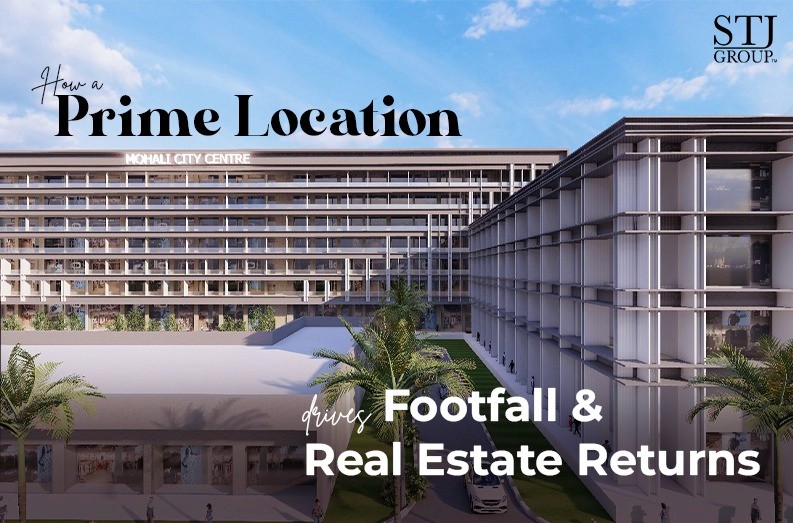
How a Prime Location Drives Footfall and Real Estate Returns
Every commercial property listing in Mohali says the same thing: "prime location on Airport Road." Scroll through ten different developer sites, and you'll read some version of that line ten times. It's technically true. It's also functionally useless — because Airport Road isn't one location. It's a five-kilometre stretch with wildly different footfall, visibility, and rent potential depending on exactly where you stand on it.
Two shops on the "same" prime road can post completely different numbers within a year of opening. Nobody tells you why in a brochure.
This post breaks down what "prime location" actually means in measurable terms, using STJ Group position in Aerocity, F-Block, as the working example — not as a sales pitch, but as a case study in how to evaluate any stretch of road before you buy.
Why "Prime Location" Is Too Broad a Term to Be Useful
Ask ten real estate agents to define "prime location," and you'll get ten versions of the same three words: visibility, accessibility, footfall. Ask them how to measure any of it, and most will change the subject.
A unit 50 metres from a busy intersection and a unit 400 metres down the same road — technically on the "same" prime stretch — can carry rent premiums that differ by 20 to 30 percent. The address doesn't change. The economics do.
So before comparing "prime location" claims across projects, it helps to break the term into the specific variables that actually move numbers, rather than accepting it as a single, unquestioned selling point.
Variable 1: Road Width and Line-of-Sight
STJ Group sits on 200-ft-wide PR-7 Airport Road. Width matters here for a few concrete reasons: it determines vehicle speed, the number of lanes visible from a shopfront, and how far a signboard can actually be read from moving traffic. A showroom on a 200-ft road with a clean, unobstructed frontage is a fundamentally different visibility asset from the same showroom set back on a 60-ft internal lane — even if both are, on paper, "three plots from the main road."
This is also why "double-height showroom" shows up in commercial listings as a specific, repeated feature rather than a design flourish. The extra vertical glass area compounds the road-width advantage. It gives passing traffic a bigger, longer window in which to actually register the storefront — not just drive past it.
Width alone, though, doesn't guarantee anything. A wide road with heavy traffic congestion at peak hours can slow vehicles enough that visibility improves, or it can push drivers to avoid the stretch entirely during rush periods. Both outcomes are possible on the same road, which is why road width should be read alongside traffic flow patterns, not as a standalone metric.
Variable 2: Distance to the Nearest High-Traffic Node
Footfall doesn't distribute evenly across a corridor. It clusters near intersections, transit points, and anchor destinations, then tapers off the farther you move away.
For STJ Forum, the relevant node is its proximity to Shaheed Bhagat Singh International Airport, roughly a five-minute drive away.
Airport proximity, though, behaves differently depending on what's being rented. A hospitality or F&B unit benefits directly from traveller footfall — people arriving hungry, tired, or with a few hours to kill before a flight. A back-office corporate lease barely notices any of that. What that tenant actually cares about is parking availability, road access during staff commute hours, and proximity to residential catchments where employees actually live — airport traffic is close to irrelevant to their decision.
This is the single most common mistake in "prime location" marketing: treating footfall as one number, when it's really several distinct footfall streams, each mattering to a different category of tenant. A number that excites a retail brand may mean nothing to an office tenant evaluating the same address.
Variable 3: Catchment Density Behind the Frontage
The road-facing side of a project captures visibility. The catchment behind it — the residential townships, universities, and offices within a two-to-three-kilometre radius — is what actually converts that visibility into repeat footfall, rather than one-time drive-by traffic that never returns.
Aerocity's surrounding catchment includes established residential development and institutional presence across the wider Mohali corridor. That matters far more for a hypermarket, food court, or multiplex — businesses that depend on repeat weekly visits — than it does for a showroom whose economics run almost entirely on road visibility and occasional purchases.
This is also why a project's tenant mix functions as a location signal in its own right. Hypermarket and F&B anchors placed alongside SCOs and showrooms tell you the developer is underwriting catchment depth, not just betting on road frontage. It's a quieter signal than "prime location on Airport Road," but arguably a more honest one — because anchor tenants only commit after doing their own footfall diligence, and their presence effectively outsources some of that research to you.
Turning This Into a Location Score, Not a Location Claim
Instead of accepting "prime location" as a marketing line, it's worth scoring any stretch of road on these three variables independently, rather than treating the address as a single pass/fail label.
Variable | What to Check | Why It Matters |
Road width & visibility | Frontage width, lane count, signage sightline, peak-hour congestion | Drives showroom and retail rent premium |
High-traffic node proximity | Distance to airport, transit hub, or major intersection | Value depends heavily on tenant type |
Catchment density | Residential/institutional population within 2–3 km | Converts visibility into repeat, recurring footfall |
A unit can score high on one variable and only average on another — and that specific combination should directly shape what you expect to pay and what return you can realistically underwrite. Paying a flat "prime location" premium across every unit type in a project, regardless of which of these three variables actually applies to your use case, is how investors end up overpaying for visibility they don't actually need.
A Quick Gut-Check Before You Sign Anything
If you're evaluating a unit on any "prime" stretch — not just Airport Road, not just Mohali — three questions tend to cut through the marketing language fast:
Which of the three variables above is this specific unit actually strong on, and which is it weak on?
Does that strength match what I plan to rent or use the space for?
Has an anchor tenant already committed to this catchment, or am I the one taking the footfall bet first?
None of these questions require specialized real estate expertise to ask. They just require treating "prime location" as a claim to verify rather than a fact to accept.
Final Take
"Prime location drives footfall and returns" isn't wrong. It's incomplete. The location itself doesn't drive anything on its own — the specific combination of road geometry, traffic-node proximity, and catchment depth does, and that combination shifts meaningfully across every hundred metres of the same road.
Before treating any Airport Road listing — STJ Forum included — as automatically "prime," it's worth asking which of these three variables it's genuinely strong on, and whether that strength lines up with what you're actually planning to do with the space. That distinction, more than the address itself, is what separates buying a location from buying a return.